

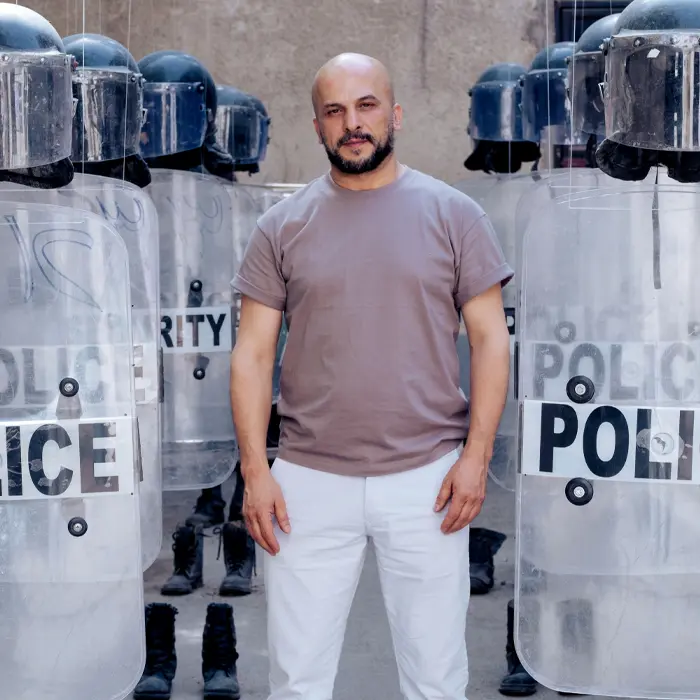
Khaled Barakeh is a multidisciplinary artist whose practice moves between conceptual art, social transformation, and institutional imagination. Educated in Syria and later holding postgraduate degrees from institutions in Denmark and Germany, he developed what he calls “The Practice of Necessity,” a methodological framework that positions art as an adaptive system responding to urgencies. Among others, Barakeh collaborates with organisations such as the European Centre for Constitutional and Human Rights, Amnesty International, the Danish Refugee Council, and Impunity Watch. His practice has been supported by funders and programmes including the Ford Foundation, Creative Europe, the German Federal Ministry for Economic Cooperation and Development, and the Arab Fund for Arts and Culture.
His work has been exhibited internationally at major shows, including the Shanghai Biennale, Mathaf Doha, the Museum for Modern Art Frankfurt, the Busan Biennale, SALT Istanbul, Museum aan de Stroom Antwerpen, and Dom Museum Vienna. Notable solo exhibitions include The Blue Hour at the Museum für Kunst und Gewerbe in Hamburg, and The Shake at The Metroblitan in Belfast. His curatorial projects include the Syrian Annual Exhibition of Visual Arts at the National Gallery in Damascus; ABSENCED at Malmö City Library in Sweden; Occupied Stage at Flutgraben in Berlin; and Pharmakon State at a former detention facility in Syria.
His work has been collected internationally, including in private and public art collections. In 2023, he was shortlisted for the Exile Visual Arts Award by Körber-Stiftung and the Exil Museum in Berlin. His writing has appeared in publications including Politics of Visual Arts in a Changing World (Columbia University, 2026), Global Photography: A Critical History (Bloomsbury, 2020), and Syrian State Torture on Trial (German Federal Agency for Civic Education, 2023).
In 2017, he founded coculture, a Berlin-based nonprofit supporting displaced and underrepresented cultural producers, and in 2026, he established a sister organisation in Damascus called ثقافة مشتركة. Through these initiatives, he is leading long-term projects, including a transnational mapping platform connecting artists from conflict-affected contexts to global networks (theindex.art) and the Syrian(s) Biennale, with a primary edition in Syria and satellite formats in cities with significant Syrian communities, including Istanbul, Paris, and Berlin. Recently, he was appointed an independent consultant at the Syrian Ministry of Culture to develop a national strategy to strengthen locally rooted cultural ecosystems.